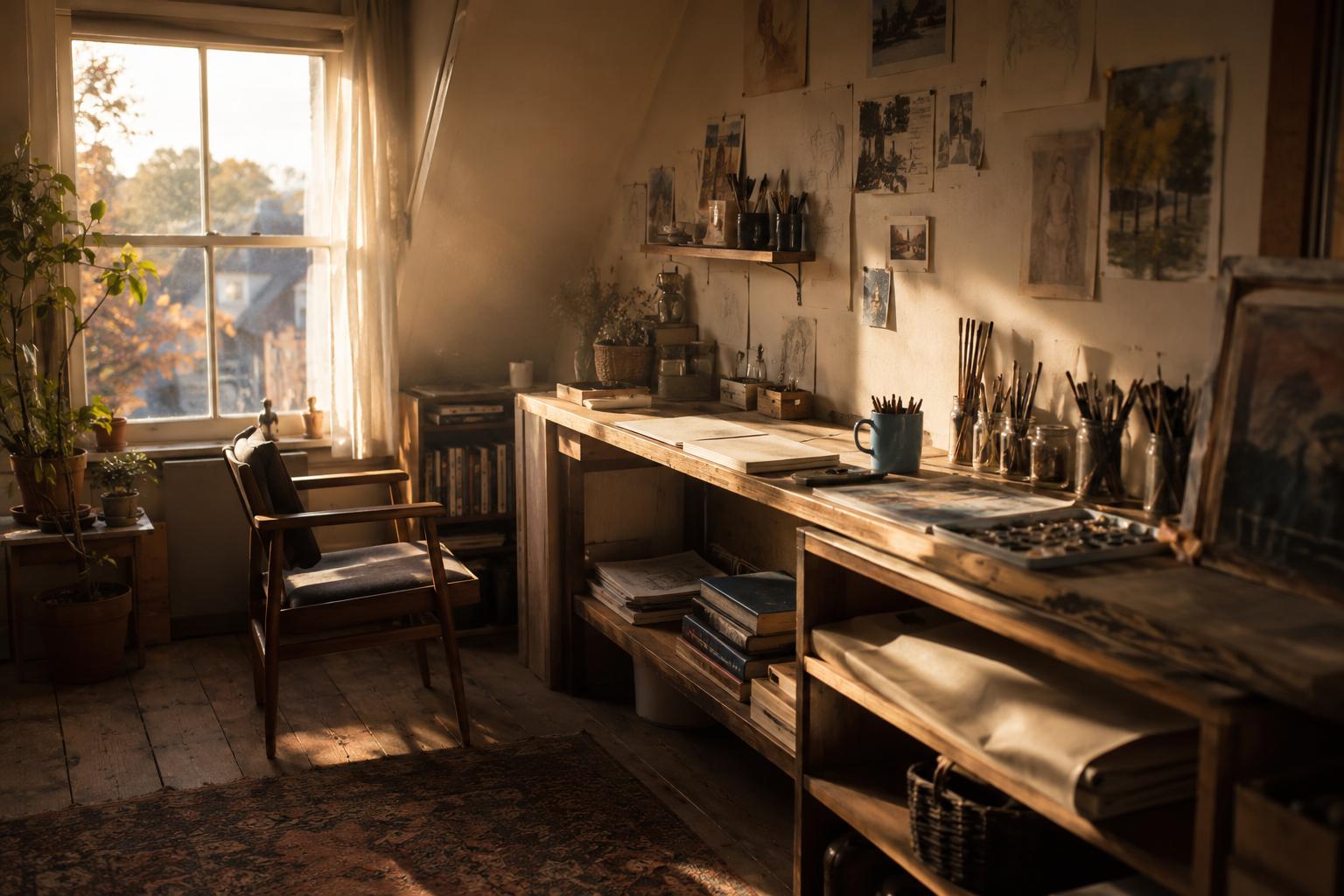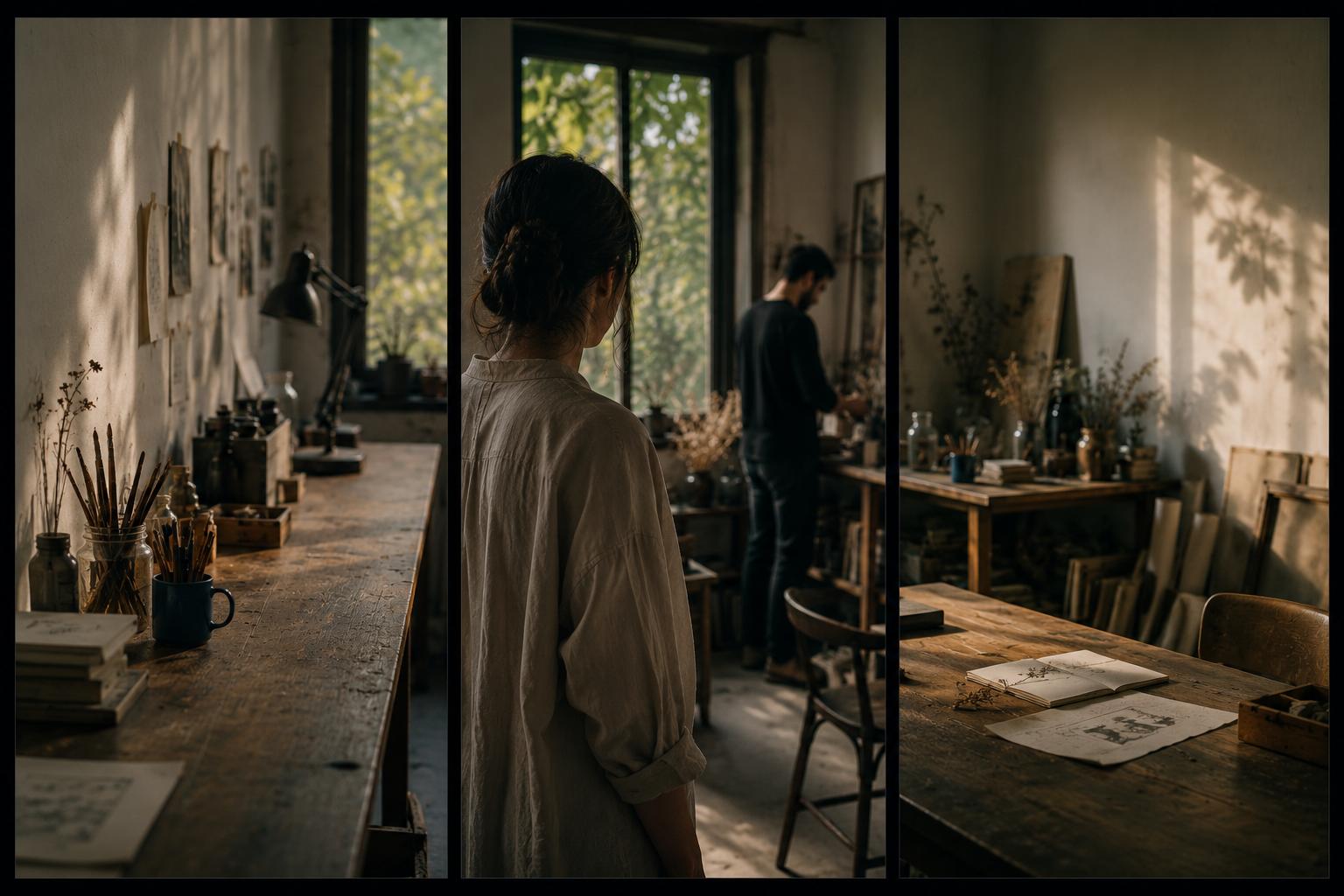
By the time Iren’s box was nearly full, the studio had grown golden and unfamiliar.
She stood near the window, looking across the room without meaning to study it. Theo was at his desk, sorting brushes into jars. The worktable stretched between them, scratched and sunlit, but not where it used to be.
That was the first thing she noticed.
The table had been moved closer to the wall.
Not much. Only enough to change the path through the room. Only enough for Iren’s body to hesitate before walking around it.
Then other things appeared.
The jars of brushes were arranged by height instead of colour. The rolls of paper had moved from the corner to the shelf near the sink. The blue mug that used to sit beside the kettle was now holding pencils near Theo’s desk.
Nothing was wrong.
That was the strange part.
The studio was clean in some places, messy in others, alive in a way that did not seem to need her permission. It had not been abandoned after she left. It had continued. Quietly, practically, almost kindly.
Iren looked at her old chair.
It was by the window now, turned toward a stack of sketches she had never seen.
Theo followed her gaze.
“I had to move things around,” he said.
His voice was careful, but not apologetic.
Iren nodded. “It makes sense.”
“It felt odd for a while.”
She looked at the table again. “It still does.”
The words came out simply. There was no accusation in them, only recognition.
Theo rested one hand on the back of the chair. “I didn’t want it to look like I was erasing anything.”
“I know.”
And she did know.
That made the ache quieter, but not smaller.
For a long time, part of her had imagined the studio waiting exactly as she had left it: the blue mug by the kettle, the brushes sorted by colour, her chair angled toward the table, the room holding its breath until she returned to collect the last of herself.
But rooms did not wait like that.
Neither did people.
Iren looked into her box. The folded canvas lay on top, rough edge visible. She touched it once, then lifted it out.
Theo watched but did not speak.
She walked to the shelf near the window and placed the canvas there, beside the rolled paper and the jars of thread.
Theo’s expression changed slightly. “You don’t want to take it?”
“I do,” Iren said. “But I think it belongs here.”
The sentence surprised her with its softness.
She stepped back. The canvas did not look abandoned on the shelf. It looked returned.
The studio was still different. The table was still in the wrong place. The mug was still full of pencils. Her chair was still turned toward work that no longer included her.
But the wrongness had shifted.
It was no longer only proof that she had been replaced by a new arrangement. It was also proof that something had lived after her leaving — not against her, not without meaning, simply forward.
Theo picked up the blue mug and looked at it. “I can move this back.”
Iren smiled faintly. “No. It looks useful there.”
“It is.”
“Then leave it.”
The quiet that followed was easier than the earlier ones.
Iren closed her box. It was lighter than she expected.
Near the window, dust moved through the late light. The long table held its scratches. The shelf held the canvas. Theo’s new sketches waited near the chair.
Nothing had to be missing for the room to show that something had changed.
Iren lifted the box.
At the door, she looked back once.
The studio did not look as it should have.
But perhaps it looked as it needed to now.