By early evening, most of the sitting room had become boxes.
Books lined the floor in short, uneven towers. The curtains had been taken down and folded badly across the armchair. The old cabinet stood half-empty against the wall, its glass doors reflecting the room in dull, uneven pieces.
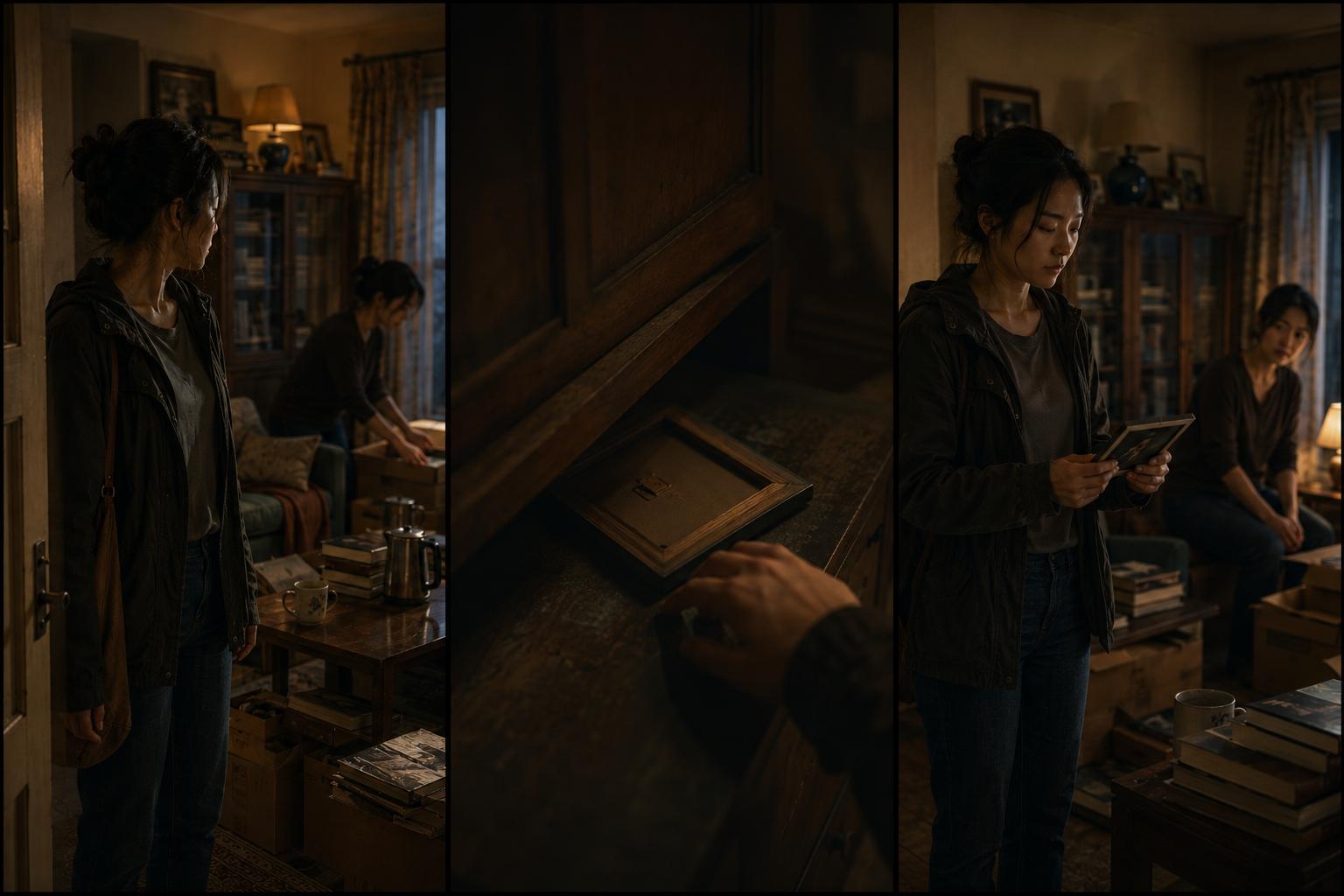
Mira stood near the doorway, watching June search for the missing roll of tape.
“It was here,” June said.
“You said that about the scissors.”
“And I was right.”
“You found them in your pocket.”
“That still counts as here.”
Mira almost smiled.
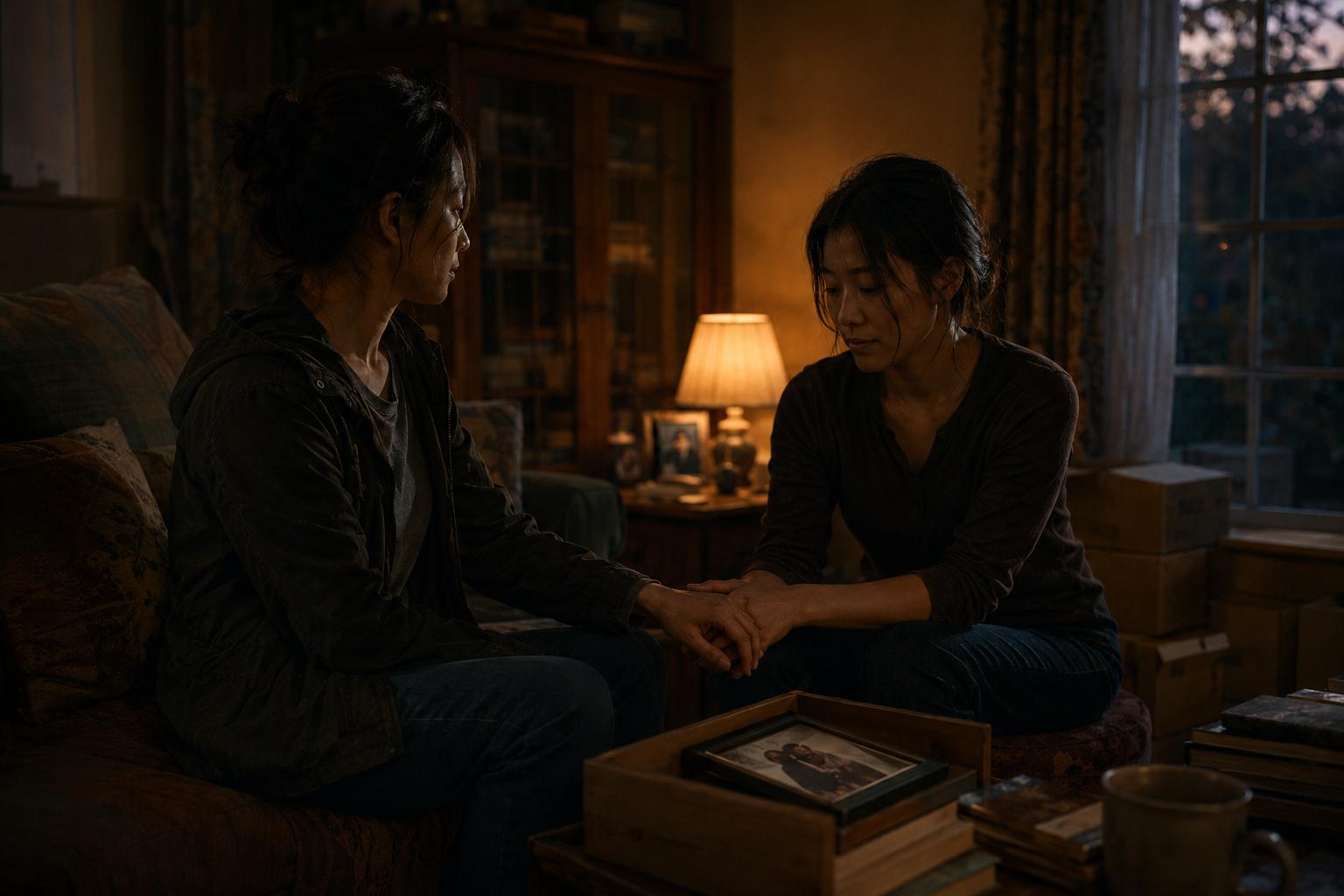
The room was dimmer now. Only one lamp had been switched on, and its light gathered in a small golden circle near the sofa. Beyond that circle, the corners of the room had begun to soften into shadow.
Mira should have been tired of noticing the room.
But something near the cabinet kept pulling at her attention.
Not directly.
It was more like a small pressure at the edge of her sight. Each time she turned toward June, or reached for a book, or looked down into a box, she felt it there — quiet, persistent, half-present.
A shape on the lower shelf.
A thin frame, perhaps.
Face-down.
Mira looked away from it.
June found the tape under a folded blanket and held it up. “Evidence of betrayal.”
“By the blanket?”
“By the room.”
The sentence was light, but Mira heard the truth beneath it. The room did feel as if it had been keeping things from them. Or perhaps keeping them until someone finally noticed.
June knelt beside a box and began sealing it.
Mira moved toward the cabinet without deciding to.
The face-down frame lay partly hidden beneath two old magazines and a loose envelope. Dust had collected along one edge. It looked ordinary, almost nothing.
Still, her hand paused before touching it.
For a moment, she thought of leaving it there.
That would be easy. The frame could remain face-down. The box could be sealed. The cabinet could be emptied by someone else. Renovation could turn the wall smooth and clean, and whatever waited there could stay unnamed beneath fresh paint and new flooring.
But the room had become too quiet for pretending.
Mira lifted the frame.
The photograph inside showed two girls sitting on the sitting room floor. Mira and June, both teenagers. June had one arm around Mira’s shoulders, pulling her close. Mira was laughing hard, her head tilted toward her sister. Behind them, the old sofa was covered in laundry, and the television screen caught a blur of light.
It was a messy photograph.
A happy one.
Mira remembered the day immediately.
Not the whole day. Just fragments. Rain against the window. June burning toast in the kitchen. Their mother telling them both to stop laughing because she was on the phone. Mira lying on the carpet while June tried to braid her hair and failed.
Then she remembered what came after.
The argument had happened the next evening.
Not in one sudden explosion, but in small sharp sentences that gathered speed. Their father’s illness. June staying home more. Mira preparing to leave for university. Who was helping. Who was escaping. Who had the right to be tired.
Mira had said something she had carried for years without looking at closely.
“You only stayed because you were afraid to leave.”
June had gone very still.
Then June had said, “And you only leave because you’re afraid to stay.”
After that, the room had felt too small for both of them.
Mira left for university two weeks later.
She told herself distance would make things easier. In some ways, it did. Their calls became practical. Birthdays polite. Visits short. The old argument dissolved into something they could avoid because neither of them named it.
But avoidance was not the same as disappearance.
The photograph trembled slightly in Mira’s hands.
June had stopped taping the box.
“What is it?” she asked.
Mira turned the frame toward her.
June looked at it without speaking.
The lamp hummed faintly beside the sofa. Outside the window, evening pressed against the glass. Somewhere in the building, a door closed, then silence returned.
June’s face changed, but only a little. Her mouth softened first. Then her eyes lowered to the photograph as if she had expected it and dreaded it at the same time.
“I forgot about that one,” she said.
“Me too.”
Neither of them said anything else for a while.
Mira looked back at the photograph. In it, they were sitting close enough to belong to the same laughter. She had remembered the argument so clearly, but not this. Not the ease before it. Not the evidence that they had once known how to be beside each other without choosing every word carefully.
“I think I kept remembering the wrong part,” Mira said.
June looked at her.
Mira’s voice stayed quiet. “Or not wrong. Just not all of it.”
June sat back on her heels. The tape rested loosely in her hand.
“I remembered the bad part,” she said.
Mira nodded.
“So did I.”
The admission did not repair anything. It only made the room more honest.
Mira ran her thumb along the frame. “I don’t think I ever came back properly.”
June looked at the photograph for a long moment.
“No,” she said.
The word was not cruel. That made it harder to hear.
Then June added, “But you’re here now.”
Mira looked at her sister.
The sentence was small. Plain. It did not forgive everything. It did not pretend the years between them had been simple. But it left space beside the truth instead of closing around it.
Mira breathed in slowly.
The dim corner no longer felt like it was pulling at her from the edge of the room. The thing hidden there had become visible. Not less painful, exactly. But less strange.
June stood and came closer.
“Keep?” she asked.
Mira looked at the photograph once more — the two of them laughing on the floor, caught before the words that came later, before distance learned to sound reasonable.
“Yes,” Mira said. “But not packed away with the others.”
June glanced at her.
“Separate box?”
“For now.”
June nodded.
Together, they found a small empty box near the sofa. Mira placed the frame inside carefully, face-up. June added a few other photographs beside it, then stopped before closing the lid.
Neither sister moved to cover it.
The room was almost dark now. The lamp light touched the edge of the box, the old cabinet, the scattered books, the floor where their younger selves had once sat laughing.
For the first time that evening, the corner did not seem to be hiding anything.
It was only a corner.
The room was only a room.
And yet something between Mira and June had shifted — not enough to call healed, not enough to explain, but enough that the silence no longer needed to hold everything alone.
Mira sat beside the box.
June sat a little way from her.
After a while, June said, “The wallpaper really does have to go.”
Mira looked at the wall, then at her sister.
“Yes,” she said. “It really does.”
June smiled faintly.
Mira did too.
Outside, the last of the light left the window. Inside, the photograph remained face-up between them, quietly visible in the small circle of lamplight.