Mira arrived at the family flat just before the light began to soften.
The hallway smelled faintly of old paint, paper, and the lemon cleaner her mother had always used on weekends. Nothing about it should have surprised her. She had grown up passing through this narrow corridor, brushing her fingers along the wall, stepping around the small shoe rack, hearing the sitting room television before she reached the door.
Still, she paused before entering.
From inside the room came the sound of cardboard shifting.
Then books.
Then packing tape.
June was already there.
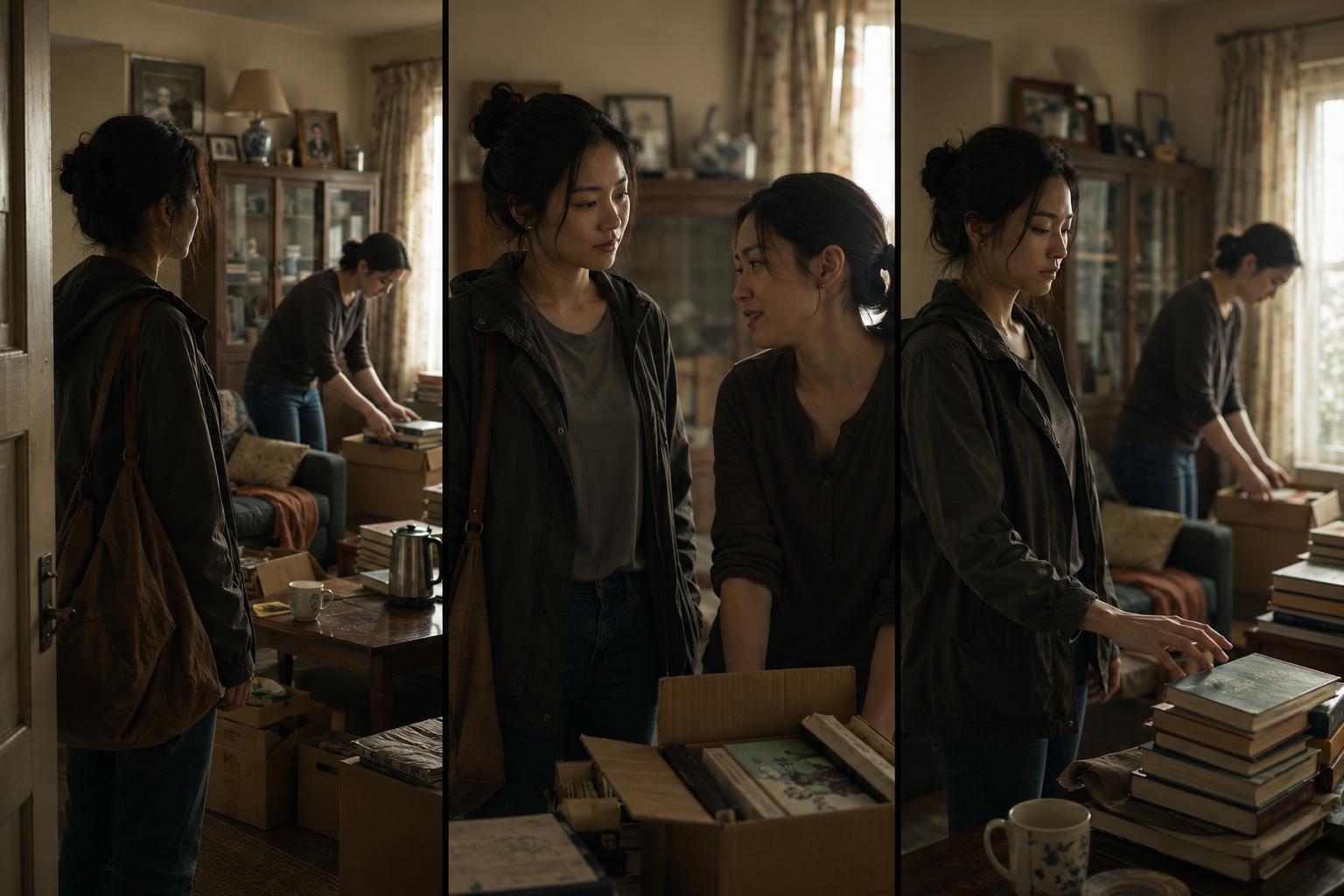
Mira stood in the doorway for a moment, one hand still on the strap of her bag. Her older sister sat on the floor beside a half-filled box, sleeves rolled up, hair loosely tied back, sorting books into two piles. One pile looked organized. The other looked like it had been created by someone who had lost patience with categories.
“You’re early,” June said, without looking up.
“I thought you said four.”
“I said around four.”
“That usually means after four.”
June placed a book into the box. “You’ve been away too long. The rules changed.”
It was almost a joke.
Mira gave a small smile and stepped inside.
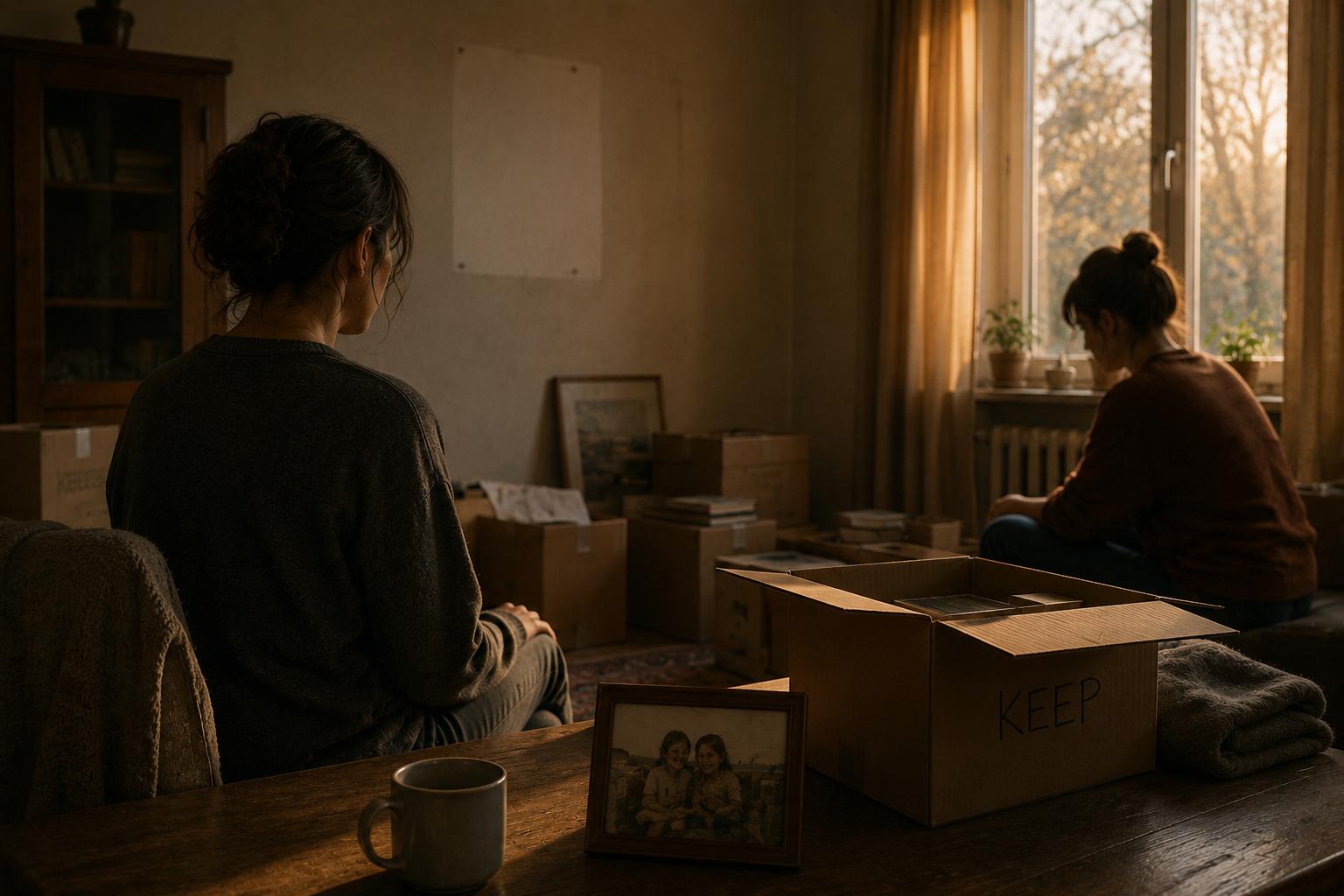
The sitting room looked both familiar and temporarily undone. The sofa had been pushed away from the wall. Curtains hung loose from one side of the window. Two cardboard boxes sat near the cabinet, one marked KEEP, the other unmarked, as if neither sister wanted to be responsible for naming what should leave.
Renovation, June had called it on the phone.
Just one room, she had said. New paint. New floor. Maybe finally get rid of that cabinet no one likes but everyone defends.
Mira had agreed too quickly. She had said yes before she could think of a reason to hesitate.
Now she stood in the room and felt the hesitation arrive late.
Outside, a bus passed along the main road. Its engine hummed through the glass, then faded. In the kitchen, the kettle clicked once and began to heat. June tore a strip of tape with her teeth and pressed it across the bottom of a box.
“Books first?” Mira asked.
“Books first. Curtains if we still like each other after.”
Mira set down her bag and knelt beside the coffee table. “That sounds optimistic.”
“About the curtains?”
“About still liking each other.”
June looked at her then, quickly.
Mira kept her eyes on the books.
For several minutes, they worked with the careful rhythm of people who knew how to share space without touching the dangerous parts of it. Mira stacked old paperbacks. June opened drawers. The kettle finished boiling in the kitchen and clicked off with a small, final sound.
The room filled itself with ordinary noise.
Tape pulling from the roll.
Cardboard edges scraping the floor.
A book spine cracking softly as Mira opened it and found a bus ticket tucked between the pages.
June carried two mugs from the kitchen and placed one near Mira’s knee.
“No sugar,” she said.
“I don’t take sugar.”
“You used to.”
“When I was twelve.”
“You were easier to feed then.”
Mira looked up. “I’m not sure that was true.”
“It was not,” June said.
This time the smile between them held for almost a full second.
Then it passed.
Mira took the mug. It warmed her fingers. She looked around the room and noticed small absences: pale squares on the wall where pictures had been removed, dust lines along the shelf, the faint dent in the carpet where the old side table had stood for years.
The room was being emptied before it was changed.
That seemed practical.
That seemed sensible.
Still, each cleared space looked less like progress and more like a question.
June reached behind the sofa and pulled out a folded blanket. “Do you want this?”
Mira recognized it at once. Grey wool, one corner slightly frayed.
“You kept that?”
“It was in the cupboard.”
“We used to fight over it.”
“You used to steal it.”
“I used to borrow it.”
“You used to leave with it.”
The words were light.
Too light.
Mira looked at the blanket in June’s hands.
June seemed to realize what she had said only after the sentence had entered the room.
For a second, her expression tightened. Not much. Just enough.
She bent over the box and added, almost casually, “You always did leave before the difficult part.”
The kettle made a small settling sound in the kitchen.
A car passed outside.
Somewhere above them, a pipe clicked behind the wall.
Mira gave a short laugh because that seemed like the safest shape for an answer.
But the laugh did not land.
It fell between them and stopped.
June folded the blanket once, then again, too neatly. Mira looked down at the book in her hands. She had not read the title. Her thumb rested against the edge of the cover, unmoving.
The room continued to make sounds.
A bus sighed at the stop outside.
The window glass trembled faintly.
A strip of tape peeled loose from the side of a box.
But beneath those sounds, a silence opened.
It was not the silence of nothing happening. It was fuller than that. Heavier. It seemed to gather itself in the space between the sisters, pressing gently against the table, the books, the open boxes, the cup cooling near Mira’s knee.
June cleared her throat.
“I meant the packing,” she said.
Mira nodded.
“Of course.”
The answer came too quickly.
Both of them heard it.
June placed the blanket in the unmarked box. Mira reached for another book, but her hand stopped above the stack.
She could feel June nearby, busy again, practical again, retreating into the safer motion of sorting and folding. Mira understood the retreat. She had used it herself for years. Polite messages. Short visits. Work schedules. Train times. Every explanation reasonable enough to hide behind.
The old disagreement had not been mentioned since it happened.
Not directly.
They had argued in this room, years ago, on a late evening after their father’s illness had already changed the shape of the family. June had said Mira was leaving too much to others. Mira had said June made staying sound like virtue. The words had sharpened quickly, faster than either of them expected.
Then Mira had left for work in another city.
At first, distance had felt like relief.
Later, it became habit.
Now the same room held them again, but differently. The sofa, the cabinet, the window, the old carpet — everything ordinary seemed aware of them.
Mira lowered her hand onto the top book.
Its cover was cool.
“I didn’t only mean to leave,” she said.
June stopped moving.
The sentence was small, and not enough. Mira knew that as soon as she said it. But it was more than they had allowed before.
June did not turn immediately.
Outside, the bus pulled away from the stop. Its sound faded down the street.
“What did you mean to do?” June asked.
Her voice was even.
Mira looked at the pale rectangle on the wall where a family photo had once hung.
“I don’t know,” she said. “At the time, I think I meant to breathe.”
June said nothing.
Mira wished she had said it better. Less selfishly. Less late.
But the silence after this sentence was different from the earlier one. It still had weight, but it no longer felt sealed shut. Something had entered it. Not forgiveness. Not yet. Not even understanding.
Only the possibility that they were no longer pretending the silence was empty.
June picked up another book.
After a moment, she said, “I know.”
Mira looked at her.
June kept her eyes on the box. “I didn’t then. But I know more now.”
The words were quiet enough that they could almost have been mistaken for part of the room.
Mira nodded, though June was not looking.
The light shifted slightly, moving across the wall in a pale band. Dust floated through it, slow and visible. The sitting room felt unfamiliar for a moment, not because anything had changed, but because something had been named only halfway.
June reached for the tape.
Mira reached for the books.
They continued sorting.
Neither sister looked directly at the other for a while, but the space between them had altered. The room still held the boxes, the old blanket, the cooling mugs, the pale marks on the wall. It still held what had not been said fully.
But now it also held one sentence.
Small.
Unsteady.
Enough to make the silence less like a wall and more like a doorway they had not yet crossed.
Mira placed three books into the box marked KEEP.
Her hand paused above the fourth.
Not because she did not know where it belonged.
Because for the first time that afternoon, she could feel the quiet asking them to stay with it a little longer.