Clara arrived by train just before noon, when the town square was still busy enough to pretend nothing had changed.
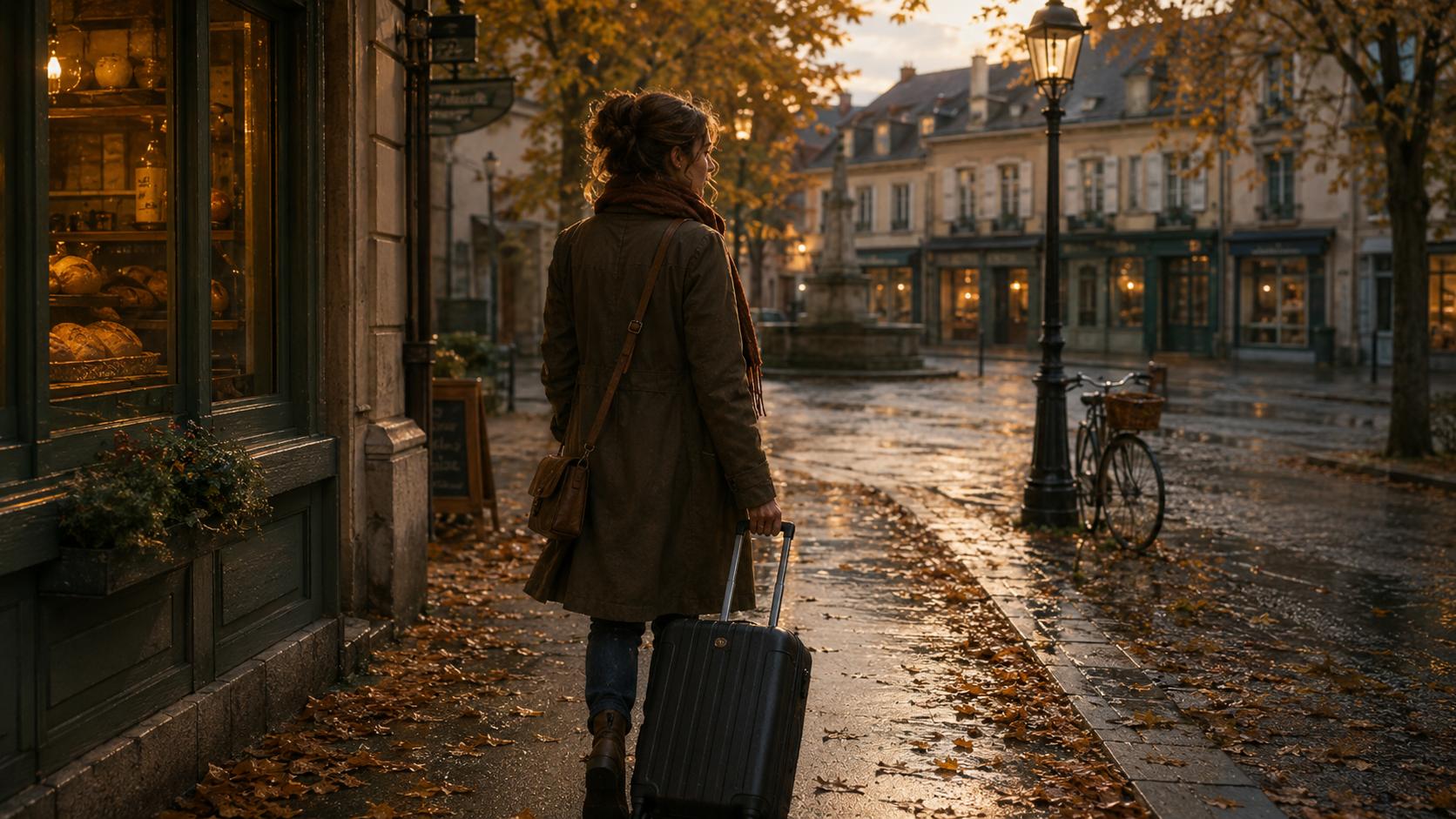
She pulled her small suitcase across the uneven pavement, its wheels clicking softly over the cracks. The station was behind her now, and the old town square opened ahead: the pharmacy with its green sign, the narrow bakery window filled with round loaves, the bicycles leaning against the railing, the bus turning slowly at the corner.
It all looked ordinary.
That was what unsettled her first.
Clara had expected the town to feel smaller, or stranger, or somehow less real after so many years away. Instead, it stood before her with quiet confidence, as if it had not been waiting for her at all. The streets had aged, but gently. The trees were taller. A few shopfronts had changed names. Yet the air still carried the same softened autumn light she remembered from childhood.
She adjusted the strap of her bag and told herself to keep walking.
There was work to do. Her grandmother’s house needed clearing before the sale could be completed. Papers had to be sorted. Cupboards emptied. Drawers opened and decided upon. Clara had come prepared for practical tasks, not for feelings.
Then she passed the bakery.
The door opened, and the smell of warm bread drifted into the street.
Clara stopped.
It was not a dramatic stop. No one noticed. A woman passed behind her with a shopping bag. Somewhere nearby, a bicycle bell rang. The town continued its small movements around her.
But inside Clara, something had opened.
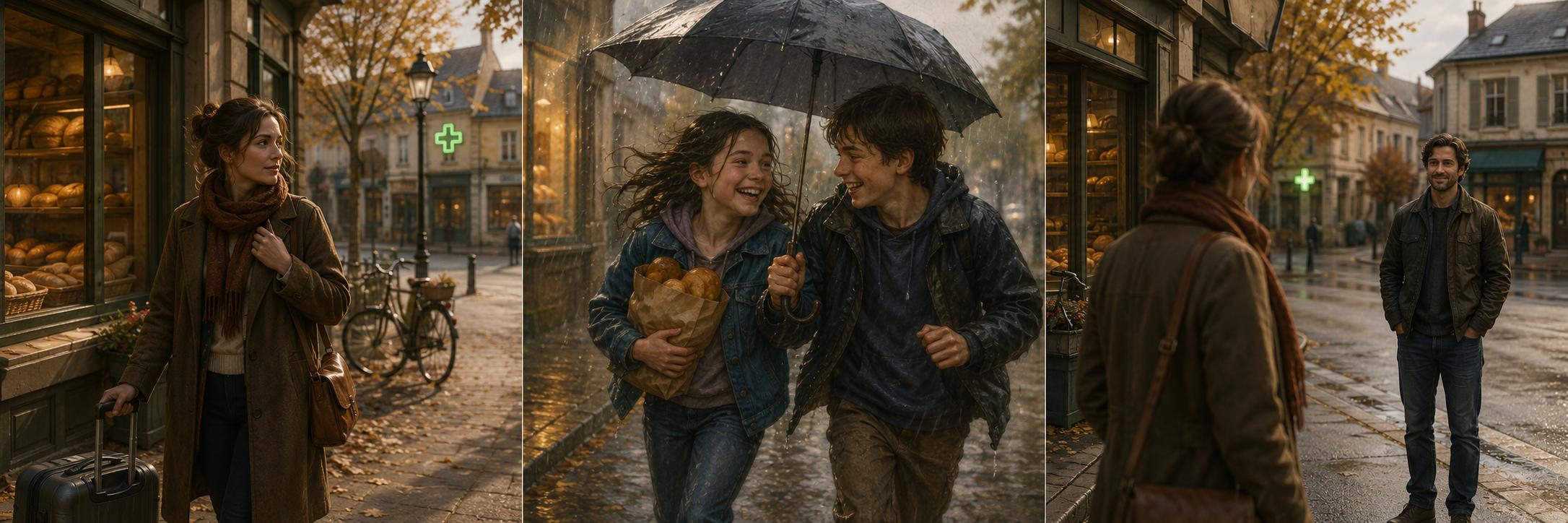
She was thirteen again, running through rain with Noah beside her, both of them laughing too loudly under one umbrella that was far too small for two people. Her socks were wet. Her hair stuck to her cheeks. Noah had bought two sweet buns from the bakery with coins they had counted three times under the awning. They had eaten them too quickly, tearing the paper bag in half so each could hold one warm piece.
Her grandmother had scolded them later for coming home soaked.
But not very seriously.
The memory arrived with such brightness that Clara almost turned toward it as if someone had called her name.
She could see the rain. She could hear Noah laughing. She could feel the paper bag softening in her damp hands. Nothing about it felt far away. The years between then and now seemed suddenly thin, like a curtain stirred by wind.
Clara looked at the bakery window.
The loaves were arranged in neat rows. A young assistant placed fresh pastries behind the glass. The brass bell above the door trembled once as it closed.
She breathed in slowly.
“Clara?”
The voice came from across the street.
She turned.
For a moment, she saw the boy from the memory before she saw the man standing there. Noah was older now, of course. His shoulders were broader, his face more lined than she had expected, his hair a little untidy in a way that felt familiar before she could name why. He stood outside a small repair shop near the corner, wiping his hands on a cloth, looking at her with surprise that softened almost immediately into a smile.
“Clara Hart,” he said. “I thought that was you.”
She crossed the street because there was no graceful way not to.
“Noah,” she said, and heard how careful her own voice sounded.
He smiled again, not pushing past the awkwardness. “It’s been a while.”
“A long while.”
The words sat between them, simple and not quite enough.
Noah glanced at her suitcase. “You just arrived?”
“Yes. I’m going to the house now.”
He nodded, understanding without needing her to say which house. “I heard about your grandmother. I’m sorry.”
“Thank you.”
Clara looked down briefly. The politeness came easily. It gave her something to hold. She had become good at answering sympathy in clean, manageable sentences.
Noah folded the cloth in his hands. “She used to come by the shop sometimes. Usually with something that wasn’t broken, but that she wanted checked anyway.”
Despite herself, Clara smiled. “That sounds like her.”
“She said machines deserved conversation too.”
This time Clara’s smile lasted a little longer.
A bus hissed at the corner. Someone came out of the bakery carrying two paper bags. The smell of warm bread returned, softer now, but still there.
Noah noticed her glance.
“Still smells the same, doesn’t it?”
Clara looked at him.
The question was harmless, but it reached too close to the memory. She felt suddenly exposed, as if he had seen the thirteen-year-old version of her still standing somewhere nearby, wet-haired and laughing.
“Yes,” she said. “It does.”
Noah did not ask if she remembered. That kindness made it harder to keep herself distant.
For a moment, neither of them spoke.
Then he cleared his throat lightly. “If you need help with anything at the house, I’m just here. Windows, locks, impossible drawers. I specialize in stubborn things.”
“That sounds useful,” Clara said.
“I’ve had practice.”
There was a small warmth in his voice, a careful humour that did not demand anything from her. Clara appreciated it more than she wanted to show.
“I should go,” she said.
“Of course.”
She lifted the handle of her suitcase again.
Noah stepped back slightly, giving her room, but his expression remained gentle. “Welcome back, Clara.”
The words should have been ordinary.
They were not.
Clara nodded and turned toward the street leading to her grandmother’s house. As she walked away, she felt the town rearrange itself around her. The bakery, the square, Noah’s voice, the rain-filled memory — all of it had entered the day without permission.
She had thought she was returning to handle what remained.
Now she understood that some things had remained in ways she had not prepared for.
Behind her, the bakery door opened again.
The bell rang once, bright and small.
Clara kept walking, but for several steps, the sound seemed to follow her — not from the bakery, not even from the square, but from somewhere much farther back, where a younger version of herself was still laughing in the rain.